August 2010
Correcting Recent Bodie Myths:
Let’s Set the Historic Record Straight
By
Michael H. Piatt
"This is the West, sir. When the legend becomes fact, print the legend.” The most memorable lines from the John Wayne movie The Man Who Shot Liberty Valance are well suited to Bodie. In the days when the West was wild, legend-making fiction often masqueraded as fact. Davy Crockett’s witty almanacs in the 1830s featured amusing back-woods yarns along with helpful advice. Gold in California gave rise to humbugs claiming fist-size nuggets. America’s favorite liar, Mark Twain, challenged readers to discern between fact and fancy about Nevada silver mining in Roughing It. More incredible were the adventures of real and made-up pulp fiction heroes, such as Buffalo Bill Cody, Wild Bill Hickok, and Deadwood Dick. Wild West shows, followed by motion pictures and television, created a mythical West based on make-believe. Evoking historical accuracy, these new forms of entertainment darted back and forth between imaginary and authentic details selected to attract viewer dollars.
Boomtown Bodie fostered whoppers of its own. Newspapers from San Francisco to New York City printed whimsical yarns about the “Bad Man from Bodie” along with phony reports of mineral strikes intended to manipulate stock prices and enrich insider pockets. “The mines are looking well” and other artful deceptions regularly soothed the nerves of unhappy investors. Decades later, mythmakers reinvented the old town’s past. Their tales, such as Bodie’s population once exceeded 10,000, its mines produced more than $100 million in gold, and the Standard Company built the world’s first long-distance electric transmission line do not stand up to research. Misinformation abounds, and more fabrications seem to arrive daily. Here are some tenacious Bodie falsehoods.
Myth #1: E.S. “Black” Taylor accompanied W.S. Bodey when gold was discovered at the place that would become Bodie.
Much of the confusion surrounding Bodie’s 1859 origins arises because nobody recorded the event for nearly 20 years. Not until the mining camp seethed with bonanza excitement in 1878 did anyone attempt to tell its discovery story. Joseph Wasson, recently elected to the California State Assembly, sought interviews with old-timers. But because many key players had already died, he relied primarily on memories held by two area pioneers: Terence Brodigan and Judge J. Giles McClinton. Brodigan claimed to have led a four-man prospecting party into the hills north of Mono Lake, where they discovered gold at the place that would become Bodie. McClinton, a former judge and Nevada state senator, had been a pioneering editor of Aurora’s Esmeralda Union and remembered the region’s early mining history.
Wasson published his findings in Bodie and Esmeralda, a pamphlet intended to promote Bodie’s mines to big-city investors. He added more details a year later in Complete Guide to the Mono County Mines. Incensed by impostors and skeptics, Wasson defended his research in a newspaper column, after which he conveyed Bodie’s most complete discovery story in an interview. In the words of the Daily Bodie Standard’s interviewer, “The only serious and conscientious attempt on the part of any one to collect and weave into readable shape any considerable number of these facts, and who exhibits any systematic determination to that end, is Jos. Wasson. . . .”1
Although “Bodie” had been the district’s accepted spelling from almost the beginning,2 Wasson believed the dead miner’s name was actually “Body.” In Mono County Mines he identified the prospectors who discovered gold: “Terence Brodigan . . . organized and headed a party of four (himself, John C. Doyle, Tim Garraty and W.S. Body) in quest of new diggings.” Now, some twenty years after the discovery, Brodigan had returned to Bodie and supplied Wasson with many historical details. Garraty corresponded from Virginia City, and according to Wasson, “will confirm this . . . early history of the district.” Doyle had since died.3 The journalist who later interviewed Wasson changed the names slightly: “Brodigan . . . was followed by Pat Garraty, Wm. Boyle and W.S. Body.”4
E.S. “Black” Taylor did not enter the story until he joined W.S. and others who were mining the discovery site. According to Wasson, “Body . . . in company with others, returned and went over the ground again. . . . Body with Black Taylor (a half Cherokee), had thrown up a little dugout cabin at the head of what is now Green Street.”5
Although Taylor was not among the four discoverers, he was recognized early on as the last person to see W.S. alive when the two struggled on foot during a November snowstorm. Taylor survived the wintry ordeal then abandoned the area until spring, when he returned to the mines and buried his former companion’s remains. Taylor Gulch, forming the eastern slope of the Bodie Mining District, carries his name.
Ella Cain was first to confuse the discoverers. In The Story of Bodie (1956) she omitted Brodigan and added Taylor: “That evening [W.S.] panned the dirt as his three companions—Doyle, Garraty, and Black Taylor—looked on.” 6 A string of writers corrected Cain’s error: Russ and Anne Johnson, The Ghost Town of Bodie (1967); Frank S. Wedertz, Bodie 1859-1900 (1969); and Warren Loose, Bodie Bonanza (1979). They re-established Wasson’s version by agreeing that W.S. accompanied Brodigan, Garraty, and Doyle [Boyle].
The story changed once again when Thomas Fletcher wrote Paiute, Prospector, Pioneer (1987) and stated (without documentation) that W.S. and Taylor were the district’s only two discoverers. Since then, Wasson’s scholarship has been largely forgotten, displaced by an onslaught of uninformed versions containing blatantly flawed and ridiculous statements such as, “By all accounts, Bodie was with E.S. ‘Black’ Taylor . . .” Another creative and hopelessly inaccurate account attempted to combine all variations into one, “[W.S.] was a member of a five-member prospecting party consisting of himself, Boyle, Garraty, Brodigan, and E.S. ‘Black’ Taylor.”7 None of these authors introduced new evidence. Instead, they copied and embellished each other’s errors until history has been muddled beyond recognition.
RECOMMENDED READING: For Wasson’s interview and other eyewitness accounts, see “Bodie’s Discovery Story” The most thoroughly researched, documented account of Bodie’s discovery is, Warren Loose, Bodie Bonanza: The True Story of a Flamboyant Past (Las Vegas, NV: Nevada Publications, 1979), pages 13-18. For more information on Bodie’s discovery and the evolution of the founder’s name, see, Michael H. Piatt, “Who Was W.S. Body, Bodey, Bodie?” in BODIE: “The Mines Are Looking Well . . .” (El Sobrante, CA: North Bay Books, 2003), 24-26.
Myth #2: W.S. Bodey’s first name was William, or perhaps Waterman.
After consulting aging Mono County pioneers in 1878 and 1879, Joseph Wasson concluded that “W.S. Body” was originally from Poughkeepsie, New York, and that he had resided in Tuolumne County, California, before crossing the Sierra in 1859 to search for gold. A handwritten copy of a document recorded at Sonora in 1856 reveals that “W.S. Body” deeded “one sixth undivided interest to a certain quartz claim” to “his wife Sarah.”8 Exhibiting fluid spelling, the document places W.S. in Tuolumne County, exactly as Wasson reported, and reveals that W.S.’s wife was named Sarah. Coincidentally, a Sarah Bodey in Poughkeepsie reported that her tinsmith husband had joined the California gold rush, then vanished. “He was in the habit of writing letters regularly to his family, when all of a sudden the correspondence ceased.”9
Granted the thread linking California’s W.S. Body to Poughkeepsie’s W.S. Bodey is thin, but inconsistent spelling is no reason to challenge this evidence, given the era’s liberal spelling conventions. Most compelling is the coincidental meshing of two corroborating stories that sprang independently from opposite ends of the continent.
Wasson never assigned W.S. a first name. Another Bodie citizen, Sylvanus B. Cobb, claimed his former partner in Tuolumne had been Poughkeepsie native “William S. Bodey.”10 Meanwhile, a Bodie newspaper published an article telegraphed from the New York Times that printed “Waterman” in the missing Poughkeepsian’s biography.11 These frequently quoted sources, Wasson, Cobb, and the New York Times, disagree on W.S.’s first name, but they all said he was from Poughkeepsie. Historic documents in Poughkeepsie, however, list only Wakeman S. Bodey. Two Poughkeepsie census takers, a decade apart, penned “Wakeman S. Bodey” near Sarah Bodey’s name. And the roster of firemen for Poughkeepsie’s Hose Company No. 1 lists “Body, Wakeman” on July 12, 1842.12
Twentieth-century writers were just as confused about W.S.’s identity as their nineteenth century predecessors. Ella Cain’s collection of folktales, The Story of Bodie (1956), cites Sylvanus B. Cobb: “. . . he was a Dutchman from Poughkeepsie, New York, named William S. Bodey.” Frank Wedertz relied on the New York Times for his book Bodie: 1859-1900 (1969): “. . . a native of Poughkeepsie, New York, . . . Waterman S. Bodey was a tinsmith of superior skill.” Not until Warren Loose researched Bodie Bonanza (1971) did anybody consult Poughkeepsie records. Loose realized that Bodie’s discoverer must have been “Wakeman S. Bodey.” Recently discovered documents support Loose.
So, who was the gold seeker whose wintry death gave Bodie his name? The answer lies in a single question: Where was he from? If the dead prospector left Poughkeepsie, New York, as Wasson and other contemporaries believed, he was “Wakeman S. Bodey,” sometimes spelled “Body.” Wasson recorded recollections of Mono County eyewitnesses, and his version of the discovery story remains our best source. Wasson’s research, coupled with Poughkeepsie records, leaves little doubt. Until stronger documentation is presented, my money’s on the New York tinsmith.
RECOMMENDED READING: For more information on Bodie’s discovery and the evolution of the founder’s name, see, Michael H. Piatt, “Who Was W.S. Body, Bodey, Bodie?” in BODIE: “The Mines Are Looking Well . . .” (El Sobrante, CA: North Bay Books, 2003), 24-26.
Myth #3: “601” stood for “six feet under—no trial—one rope.”
This gem materialized out of thin air, introduced to Bodie mythology a few years ago. The sudden appearance of “six feet under—no trial—one rope” belies the fact that it is not mentioned in books or articles by former area residents Grant Smith, W.A. Chalfant, Ella Cain, Emil Billeb, Frank Wedertz, or Warren Loose—strong evidence that it was never a local tradition. Yet, since 2003 the explanation has turned up in one book, a magazine article, a History Channel documentary, a CD narration, and an ever increasing number of uninformed websites. Most recently, the line was repeated on a 2009 television news broadcast.13 So far, nobody has provided documentation proving that this was the actual meaning behind “601.”
The expression “601” originated during a vigilante uprising on the Comstock. Dan De Quille (William Wright), a reporter for the Territorial Enterprise, recalled the event.
In the spring of 1871 there sprang into existence in Virginia City a secret organization known as “Six Hundred and One.” It was a “Vigilance Committee” similar to that organized in San Francisco in the early days. . . . The first that was publicly known of the organization was on the night of March 24, 1871, when Arthur Perkins Heffernan, who a short time before had shot down a man in cold blood at the bar in the principal hotel of the town, was taken from the county jail and hanged. In the morning, when the coroner went to cut down the body of Arthur Perkins, as he was commonly called, there was found pinned upon it a paper on which were the figures “601.” This was taken to be the name of the “vigilante” organization, and “601” it has ever since been called.14
If meanings for the three peculiar digits were known, De Quille did not reveal them.15 A decade later at Bodie, vigilant citizens modeled their secret committee after Virginia City’s by calling themselves “601.” In April 1880 Bodie’s press probed the mysterious group, but failed to find answers. “A party here has been handed a notice signed ‘601,’ ordering him to leave Bodie within 24 hours, or suffer the consequences. . . . But who composes the ‘601’?”16 Another investigation proved equally vague: “A report was current on the streets last (Tuesday) night and this morning that an organization calling itself "601" had notified several parties that a longer stay in Bodie would be at the risk of having their supply of oxygen curtailed. . . . The whole story lacks confirmation, however.”17
After the town witnessed a string of “dastardly murders,” an angry editor intensified the call for action and beckoned Bodie’s shadowy committee:
It is our opinion that a little “hemp practice” would be beneficial in this town. Although the majesty of the law should in all cases be sustained, there are circumstances which occur that compel the law-abiding citizens to band together for protection and wrest from the official clutches, cowardly assassins and set a signal [sic] example of them and so strike terror into the hearts of cowardly murderers, highwaymen, and robbers. Vigilance committees are sometimes an absolute necessity, and it is the general opinion of the tax paying citizens of Bodie that the sooner a 601 organization is instituted the better for this section of the country.18
Six months later, Joseph DaRoche19 fired a pistol ball into the back of Thomas Treloar’s head, but by then Bodie’s law-abiding citizens were openly impatient with incessant crime, an ineffectual police force, and the likelihood that a jury would fail to convict even a depraved killer. Yet, the local press had discovered little about the mysterious “601.” “It was currently reported on the streets last Thursday evening that a large but secret meeting of citizens was in session to devise a means for the swift and certain punishment of crime and of criminal negligence on the part of [police] officers, but what action, if any, was taken our reporter could not learn.”20
No newspaper reporting the January 17, 1881, vigilante lynching of Joseph DaRoche at Bodie disclosed coded meanings for the numerals “601.” A note pinned to the dangling body provided meager clues, bearing the inscription, “All others take warning. Let no one cut him down. Bodie 601.”21
The event led one editor to reflect, “law-and-order bluffs hard, telling what it is going to do, but 601 goes right ahead and does what it proposes without telling it all to the newspapers beforehand. In fact, it is a peculiarity with 601 that newspapers never have a chance to publish their intentions, but only their achievements.”22
Although “601” meant peril to bad guys, nowhere does “six feet under—no trial—one rope” appear in period accounts. The fable sounds good, but that does not make it true. Until a reliable source is disclosed, this tale should be viewed with more than a touch of skepticism by everyone interested in Bodie’s past.
RECOMMENDED READING: The best account of Bodie’s “601” and its lynching of Joseph DaRoche is in Roger D. McGrath, Gunfighters, Highwaymen & Vigilantes: Violence on the Frontier (Berkeley CA: University of California Press, 1984), pages 234-245.
Myth #4: Immediately before he was murdered by Joseph DaRoche, Thomas Treloar stepped outside the Miners Union hall to smoke a cigarette.23
Eyewitnesses near the hall on the frigid night of January 14, 1881, told a different story. E.S. Butler and G.W. Alexander were standing in front of Kilgore’s market, when Treloar and DaRoche passed by. According to Butler, who testified before a coroner’s inquest, “Alexander made some remark about the men being at outs about a woman. I turned and watched them until the shooting took place. The men were perfectly quiet and walking along side by side until the little man (Treloar) stepped down from the sidewalk, thus getting a little ahead of the other, when the other man (DaRoche) fired.”24
Next to Butler stood G.W. Alexander, who also testified. “I was with Mr. Butler at the market, and said to him as DaRoche and Treloar passed, ‘that’s the two gentlemen who are likely to have trouble about the wife of the smaller man.’ . . . I turned and looked after them. The smaller man appeared a step or two ahead. As they stepped off the sidewalk a shot was fired. . . . . [I] saw the men continuously from the time they passed me until the shot was fired. Saw no movement on the part of Treloar except his stepping off the sidewalk, when he seemed to pass a little to the front of DaRoche.”25
No witness recalled anyone smoking a cigarette, a form of tobacco that would not become popular until later in the decade, when automatic rolling machines made cigarettes affordable. Based on advertisements in newspapers that reported Treloar’s murder, cigars were Bodie’s preferred smoke in January 1881.
Myth #5: Bodie’s mines were hot inside, and the majority of Bodie miners died from “instant pneumonia,” an affliction caused by ascending a mine shaft too quickly from sweltering heat to bitter cold.26
Nobody who worked in Bodie’s mines ever said the ground was hot. Hundreds of articles written by mining correspondents and mine superintendents, including William Irwin, Thomas Leggett, and Theodore Hoover, reveal that people with first-hand knowledge did not complain about high temperatures underground. Reports by the California State Mineralogist, Director of the U.S. Mint, and the American Institute of Mining Engineers also fail to mention extreme temperatures below ground at Bodie. Robert T. Bell, the last surviving underground miner at Bodie, never described sweltering working conditions.
Some 85 miles to the north, however, mines on the Comstock were known for oppressive heat, first encountered in 1866 on the 900-foot level of the Belcher Mine. When the Washoe District’s mines reached 1,200 feet in 1868, 110 degree Fahrenheit temperatures required blowers and ductwork to cool work areas. Horizontal passages were also dug to connect shafts and create air currents that removed sweltering air. Meanwhile, underground workers found refuge in cooling stations supplied with ice and cold water.27
When Washoe’s mines reached 2,000 feet below the surface in 1879, temperatures as high as 150 degrees were measured, but 120 degrees were normal. Reporting Comstock mine fatalities from 1863 through 1880 for the U.S. Geological Survey, Eliot Lord counted nine miners who died from heat, all between 1876 and 1880. “Of late years heat has killed strong men in almost every deep mine on the lode, and in some mines the deaths so caused have been frequent.”28
Excessive heat below ground also proved deadly in another way. Rapid change in temperature overcame some miners riding to the surface on fast-moving cages. A sudden temperature drop from stifling heat to a winter night’s chill could produce nausea and dizziness, occasionally causing a man to slip into unconsciousness. If fellow passengers failed to catch him in time, the fainting man might collapse against the shaft wall to be ripped apart in the narrow space between the rapidly moving cage and the mine’s timbers.
While deaths occurred below ground as a result of high temperature, and men fainted aboard cages to be ground to pieces in the machinery, not once did Lord record a Comstock miner dropping dead from “instant pneumonia” during or after riding to the surface. Lord tabulated Storey County, Nevada, deaths and their causes between 1865 and 1880, but did not list “instant pneumonia.” A table of mine fatalities charted twelve workplace dangers, including cave-ins, premature explosions, fires, heat or foul air, and miners crushed by moving cages, but not “instant pneumonia.”29
Instant pneumonia is a good story, but bad history. The affliction was unknown on the Comstock and never existed at Bodie, where the deepest mineshafts reached only 1,200 feet and all available documentation indicates underground temperatures were not excessive.
Myth #6: “Goodbye, God. We’re going to Bodie!” Some authors say a little girl leaving Aurora uttered Bodie’s most famous quotation. Others claim she was from Truckee.
Neither version is correct. The quotation first appeared at Bodie on February 13, 1879, in a newspaper column reprinted from Carson City’s Nevada Tribune (which probably ripped it off from another newspaper). “‘Good-bye, God; we are going to Bodie in the morning,’ was the suggestive termination of a sweet little three-year old's prayer the other evening at San Jose, just prior to the departure of the family for the wicked mining camp mentioned. Not bad that, but rather severe on Bodie.”30
Bodie’s immediate rebuttal has been largely forgotten. “All right, pardner; but we have no particular use here for a god that confines himself to the limits of San Jose; and we don't wonder that even a little three-year-old was willing to say ‘good-bye’ when she thought she had a chance to get out of that delectable place in order to come to Bodie.”31
The newspaper that published the town’s most popular response has been lost. Its editor’s remarks, however, are preserved in a 1934 typed transcription of an unidentified 1879 Bodie daily: “We would like to make a slight correction to the punctuation of the above. It should read; ‘GOOD. By God we are going to Bodie in the morning’.”32
Myth #7: Bodie was California’s second or third largest city, surpassed only by San Francisco.
This tale first appeared (without documentation) in 1991 in an advertisement on the box for the video Bodie: Ghost Town Frozen in Time, produced by the Sierra State Parks Foundation.33 A look at the Tenth United States Census of 1880 quickly debunks the myth. Yet, despite solid documentation to the contrary, the story reappears from time to time, most recently in a 2009 television news travelogue.34 Here are the official population figures for California’s largest cities in 1880.35
Even if nearly 10,000 fortune seekers populated Bodie during its 1879-1880 grandeur, the remote mining outpost was never California’s second, or even its third, largest city. The U.S. census takers at Bodie counted only about 5,400 inhabitants. Local newspapers argued that the official enumeration was too small, citing people whose names did not appear on the list. Newsmen estimated the population at around 7,000, maybe 8,000. Nobody in 1880 said that Bodie was the state’s second or third largest city.
RECOMMENDED READING: For the actual U.S. Census, see Statistics of the Population of the United States at the Tenth Census (1880): “Population by Race of Cities and Towns, Table VI,” page 416; http://www2.census.gov/prod2/decennial/documents/1880a_v1-01.pdf
For eyewitness estimates of Bodie’s boomtown population, see http://www.bodiehistory.com/population.pdf
Myth #8: Peter Eshington and Louis Lockberg discovered the famous Fortuna Lode when their mine caved, exposing a vein that was “almost solid gold.”36
According to surviving documents and the only eyewitness account of the discovery, Peter Eshington and Louis Lockberg were working the old Bunker Hill Mine when it caved, revealing an ore body they called the “Bullion Lode.”37 The discoverers filed their claim, documented by Mono County records: “BULLION LODE, Notice: Said claim is known as the ‘BULLION LODE.’ Peter Eshington, Louis Lockburg, June 11, 1875.”38
Eshington and Lockberg mined the ledge for about a year, then sold it to San Francisco speculators, who organized the Standard Company and set up industrial-scale mining. The Bullion Lode became Bodie’s first bonanza, inciting a gold rush that began in 1877.
The “Fortuna” would not be discovered until 1879, in the adjacent Bodie Mine. The ledge was rich, described by one observer as “flecked with shining particles of pure gold.”39 The Fortuna became the Bodie Company’s primary source of revenue during the next 17 years as miners followed it 1,200 feet into the earth.
Myth #9: Peter Eshington spelled his name “Essington.”
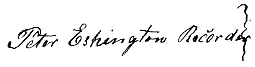
Peter Eshington and partner Louis Lockberg were working the Bunker Hill Mine when it caved in 1875, revealing an ore body that would make Bodie famous. W.A. Chalfant misspelled Eshington’s name in Outposts of Civilization (1928), followed by Ella Cain in The Story of Bodie (1956). Unwary writers have been repeating the error ever since. Peter Eshington served as district recorder during the early 1870s, and his signature appears frequently in Mono County documents.40
Myth#10: More than $100 million in gold was produced by Bodie’s mines.
In 1956, Ella Cain claimed without documentation, “the total production of all mining done in Bodie . . . is estimated to be between $95 and $100 million.”41 A bronze monument dedicated at Bodie State Historic Park in 1964 increased the error: “Bodie’s mines produced gold valued at more than 100 million dollars.”42 Despite an absence of documents, the error persists.
Bodie’s most prosperous years lay in the past by 1888, when the California State Mineralogist calculated the district’s yield to that time at $18,097,922.81.43 A century later, the California Division of Mines and Geology published yearly yields for Bodie from 1860 through 1941, the last year mineral recovery was undertaken on an industrial scale. Annual reports and estimates list the district’s total production at $33,954,919.29.44
Myth #11: Constable John Kirgan and his police officers carried Colt Peacemakers.45
Bodie’s boomtown journalists rarely described guns in detail, usually referring to a sidearm as a “pistol,” “revolver,” or “six-shooter.” When reporters identified handguns, they were usually “Colt self-cockers” or “British Bulldogs.” 46 Oddly, the antiquated “Colt Navy” revolver received occasional recognition. Contrary to Hollywood’s popular convention, Colt’s Peacemaker (a.k.a. the Single Action Army or Frontier revolver) is not named in period newspapers. Also countering popular movie mythology, handguns were generally drawn from coat or hip pockets, instead of holsters.
The only reference I found of a gun that was probably a Colt Peacemaker appeared in a newspaper account of the January 21, 1881, shooting scrape between Dave Bannon and Ed Ryan.
... Ryan staggered toward the front of the saloon. He fell up against the folding doors and out onto the sidewalk. One of [the] crowd in front attempted to raise him, at the same time asking him if he was injured. His reply was: “I couldn’t cock my gun.” The weapon used by him was a Colt’s cut-off.47
Ryan’s remark is odd, because he had just shot Bannon twice, wounding him mortally in a close-quarters struggle that was characterized by “rapid” shooting. Colt’s only single action revolver of the era that required cocking and was large enough to warrant shortening was the Peacemaker. According to the reporter, Ryan carried his gun in a “rear pocket.” Bannon was armed with a British Bulldog.
RECOMMENDED READING: For a thorough description of the fight, see Roger D. McGrath, Gunfighters, Highwaymen & Vigilantes: Violence on the Frontier (Berkeley CA: University of California Press, 1984), pages 204-205.
Myth #12: Bodie’s miners were called “hard rock” miners and its mines were “hard rock” mines.
The expression “hard rock” has become popular among modern-day writers, but was unknown to Bodieites during the district’s productive years. Because gold- and silver-bearing ore is most often comprised of quartz, the 19th century term for underground gold or silver mining was “quartz” mining, which distinguished it from washing gravel on the surface, or “placer” mining. Quotations from 1878 and 1879 demonstrate the terminology: “Already has ground been taken up for quartz mining. This, of course, does not interfere with the claimants of placer mines. There are more prospective millionaires today, in Bodie, than any other town in the State.” “Silver Hill has probably shown some of the richest ore in the Red Cloud that has ever been taken from a quartz mine. . . .” “There are probably no healthier men in the world than the underground quartz miners of Virginia [City] and Bodie. Their wages are $4.00 per day. . . .”48
Stamp mills, like those at Bodie, were called “quartz mills,” documented by period remarks: “A contract has been closed by the Spaulding Company with John N. Risdon, of the Risdon Iron Words, San Francisco, for the immediate erection of a 10-stamp quartz mill.” “There are now seven quartz mills of 125 stamps, with a crushing capacity of 250 tons per diem.” As late as 1923, J.S. Cain listed the Standard mill as a “20 stamp quartz mill.”49
Other popular Old West terms, such as “gunslinger” and “showdown,” common in Hollywood westerns, were also unknown in the 19th century.
Myth #13: The Standard Company’s pioneering long-distance electrical transmission line was “absolutely straight, no angles, no curves, which might cause the power to jump off into space.”50
When the Standard Company sought to reduce operating expenses, Superintendent Thomas Leggett chose to replace the mill’s wood-fired boiler and steam engine with an electric motor. A small hydroelectric plant would furnish electricity to run the mill at reduced cost, but the major problem facing engineers was the distance from the nearest source of reliable water power. Between 1892 and 1893, Westinghouse Electric & Manufacturing Co. designed and built a transmission line to the Standard Mill that stretched 12.46 miles cross country in nearly a straight line from Green Creek in the Sierra foothills.
Ella Cain’s popular folk tale about electricity jumping off wires on curves is nonsense. Leggett’s technical report about Bodie’s success in transmitting electrical power over a long distance did not list curved wires among the venture’s many obstacles. Nor did electrical engineering journals of the era mention the problem.51
Instead, surveyors plotted the transmission line as straight as possible for two reasons: minimize the pole line’s length, and reduce its cost. Both reasons were based on the principle that the shortest distance between two points is a straight line.
Since the mid-1880s, when urban centers began adopting electricity for lighting and trolley cars, engineers had struggled to transmit useful voltages farther than three miles. Meeting the Standard Mill’s energy requirements from a power source more than 12 miles away would be fraught with difficulties, if not impossible. To increase the odds of success, a straight transmission line afforded the shortest distance the electrical current would have to travel.
Given that the Standard Mine had been producing ore of ever-diminishing value during the previous decade, Leggett’s expendable capital was limited and he strove to control expenses. Zig-zagging from power plant to mill would only waste materials by increasing the line’s length, so he called for a direct transmission line between Green Creek and Bodie.
Although Ella Cain’s story is amusing, the fable does not account for vertical curves (hills and valleys). “The line crosses extremely rough country,” wrote Leggett in his paper to the American Institute of Mining Engineers, “not 500 yards of which is level beyond the town-limits. Most of the ground is very rocky, over 500 pounds of dynamite being used in blasting the pole-holes.”52
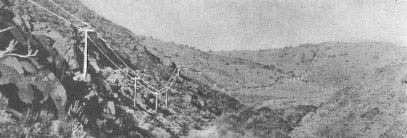
View of pole line looking east 10 miles from Bodie, circa 1893.
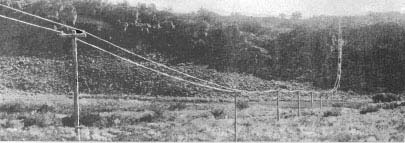
View of pole line looking west 10 miles from Bodie, circa 1893.
Perfectly straight wires would have required tunneling through hills and bridging valleys. Two photographs from the Twelfth Report of the State Mineralogist (1894) prove that the transmission line had plenty of curves. Most, however, were up and down.
RECOMMENDED READING: For more information about the Standard Company’s use of electric power, see, “Developments in Electricity and Bodie’s Long Distance Power Transmission.”
The Historian’s Responsibility
Historians have a duty to seek the most reliable sources, attempt to separate fact from fiction, and strive for the highest degree of accuracy. True history, insofar as we are able to discover and present it, is always more compelling than cheap stories by providing a fuller understanding of the human experience. Shoddy research only obscures the real drama.53
Undermining the work of serious Bodie researchers are uninformed purveyors of junk history who confuse colorful stories with recorded fact. Their books, magazine articles, websites, and video commentaries perpetuate misinformation, whether deep-rooted old myths or newly concocted fiction. The standards for historical research have tightened in the half-century since Ella Cain wrote The Story of Bodie, requiring documentation by people with firsthand knowledge—preferably eyewitnesses who recorded events as they occurred. Yet, writers continue to repeat stories without checking sources, often adding more errors with each telling.
Fiction has its place as entertainment, but fanciful crackpot stories should not be presented as fact, especially regarding Bodie, a real, historic place with a true past. Interpreters of the old town’s saga should focus on educating the public, not entertaining audiences with tall tales. But, because today’s mythmakers prefer to sidestep meaningful research, a fitting adage for Bodie might be: “Don’t bother with documentation, just make something up. If it sounds good, it must be true.”
NOTES
1Joseph Wasson, Bodie and Esmeralda: An Account of the Revival of the Affairs in Two Singularly Interesting and Important Mining Districts, Including Something of their Past History, and the Gist of the Reports of Profs. Benj. Silliman and Wm. P. Blake, the late J. Ross Browne, and State Mineralogist R. H. Stretch and H. R. Whitehill—Also, Detailed Description of Mines most Developed, Tunnels, Mills, etc.—Also, General Resources of Mono and Esmeralda Counties—With Maps and Illustrations (San Francisco, CA: Spaulding, Barto & Co., 1878), 5-6; Joseph Wasson, Complete Guide to the Mono County Mines: Description of Bodie, Esmeralda, Indian, Lake, Laurel Hill, Prescott, and Other Mining Districs—With Maps and Illustrations (San Francisco, CA. Spaulding, Barto & Co., 1879), x-xi; Daily Bodie Standard (Bodie, CA) 4 August 1879; 27 October 1879.
2 Area maps dated 1862 and 1863 show that the spelling “Bodie” was well established within two or three years after the discovery. See maps, Robert E. Stewart, Aurora: Nevada’s Ghost City of the Dawn (Las Vegas, NV: Nevada Publications, 2004), 3, 91. Also see stock certificate dated January 26, 1863, “Bodie Bluff Consolidation Mining Co.” in Michael H. Piatt, BODIE: “The Mines Are Looking Well . . .” (El Sobrante, CA: North Bay Books, 2003), 23.
3 Wasson, Mono County Mines, x-xi.
4 Daily Bodie Standard (Bodie, CA) 27 October 1879.
5Daily Bodie Standard (Bodie, CA) 27 October 1879.
6 Ella M. Cain, The Story of Bodie (San Francisco, CA: Fearon Publishers, 1956), 1-2. Despite Cain’s assertions of historical accuracy, The Story of Bodie (1956) should not be taken as factual. Born at Bodie in 1882, Cain grew up at Bridgeport then returned to Bodie in 1900 to teach school and record the stories of old-timers and the memories of her husband David Victor Cain. Her book is charming, but its historical information does not stand up in the face of research. One example is an error-ridden version of Bodie’s discovery with details and dialogue not found in period sources: “Say, old Peter,” W.S. Bodey exclaimed to his partners, “this looks like pay dirt at last. . . .” Historic records contradict Cain’s other popular fables, such as youthful prostitute Rosa May dying while nursing sick miners during a pneumonia epidemic; Bodie’s boomtown population exceeding 10,000; its mines producing nearly $100,000 in bullion; the Standard Company building the world’s first long-distance electric transmission line; and that the line was perfectly straight so electricity would not jump off the wires on curves. Although subsequent authors have corrected her mistakes, many Cain stories survive as local legends, which unwary writers repeat without question.
7 Marguerite Sprague, Bodie’s Gold: Tall Tales & True History from a California Mining Town (Reno, NV: University of Nevada Press, 2003), 4-5; James Watson and Doug Brodie, Big Bad Bodie: High Sierra Ghost Town (Bloomington, IN: Xlibris Corporation, 2000), 19.
8 Tuolumne County. “Deed: W.S. Body to Sarah Body.” Book A, Vol. 5, 530, 15 November 1856.
9 Daily Eagle (Poughkeepsie, NY) 28 October 1879.
10 Bodie Chronicle (Bodie, CA) 1 November 1879.
11 New York Times (New York, NY) 29 October 1879 in Daily Bodie Standard (Bodie, CA) 7 November 1879. Wild Bill Hickok’s biographer, Joseph G. Rosa, gave an example of lenient mid-nineteenth century spelling practices: “Court records and available newspapers from Kansas Territory in the 1850s reveal that [Wild Bill] was known alternately as William Hickok, William Hitchcock, and James Hickok or Hickox. This suggests a phonetic rather than factual interpretation of his surname. . . . By 1864, however, James Butler Hickok—variously known as William Hickok, Haycock and other variants—had earned the sobriquet ‘Wild Bill,’ by which name he became generally known.” (Joseph G. Rosa, “Little Known Facts About Wild Bill,” Wild West, December 2008, 30.)
12 Seventh Census of the United States, 1850, Dutchess County, NY, 44; Eighth Census of the United States, 1860, Dutchess County, NY, 351; Names of Persons in Actual Service in the Fire Department of the City & Village of Poughkeepsie, Adriance Memorial Library, call no. Q 363.37 B.
13 Bill Merrell with David Carle, Bodie’s Boss Lawman: The Frontier Odyssey of Constable John F. Kirgan (Reno, NV: Nevada Publications, 2003), 141; Marguerite Sprague, The Bodie Companion: Living History Interviews, Music, Photographs, Potluck Productions, Audio CD, 2005; KXTV News 10, California Postcards, 2009, “Bodie Ghost Town.” Jonathan Mumm, narrator.
14 Dan De Quille (William Wright), The Big Bonanza (Hartford, CT: American Publishing Co, 1876), 181.
15 One recent researcher is exploring the possibility that “601” was the number of an 1870s Nevada or Federal statute dealing with juries, trials, witnesses, sentencing, or some other aspect of criminal law.
16 Bodie Chronicle (Bodie, CA) 2 April 1880.
17 Daily Bodie Standard (Bodie, CA) 7 April 1880.
18 Bodie Daily News (Bodie, CA) 9 July 1880, in Loose 1979, 144.
19 Although the historic record is indecisive about the spelling of DeRoche, Bodie historians have been surprisingly consistent. Chalfant (1928) wrote “DeRoche, though he cited no source. Cain (1956) also wrote “DeRoche,” and cited no source. The Johnsons (1967) followed suit with “DeRoche,” quoting heavily from an old-timer’s reminiscence in a 1914 edition of the Carson City News. Wedertz (1969) and Loose (1979) quoted 1881 articles from the Chronicle-Union at Bridgeport, though one author chose “DeRoche,” the other “De Roche.” McGrath (1984) recounted the 1881 vigilante lynching from columns in Bodie’s Daily Free Press, which printed “DaRoche.” McGrath stuck with tradition, however, and added a footnote acknowledging the Bodie newspaper’s spelling.
20 Daily Free Press (Bodie, CA) 15 January 1881.
21 Daily Free Press (Bodie, CA) 18 January 1881.
22 Daily Free Press (Bodie, CA) 9 February 1881.
23 Marguerite Sprague, The Bodie Companion: Living History Interviews, Music, Photographs. Potluck Productions, Audio CD, 2005.
24 Daily Free Press (Bodie, CA) 16 January 1881.
25 Daily Free Press (Bodie, CA) 16 January 1881.
26 The History Channel, Wild West Tech, 2004, “Biggest Machines in the West.” Roderic Duff, commentator. David Carradine, narrator.
27 U.S. Geological Survey, Comstock Mining and Miners, by Eliot Lord (Washington, DC: Government Printing Office, 1883), 391-401; tables 404, 436-442.
28 Lord, Comstock Mines and Miners, 397; table 404.
29 Lord, Comstock Mining and Miners, tables 404, 436-442.
30 Daily Nevada Tribune (Carson City, NV) 10 February 1879; Daily Bodie Standard (Bodie, CA) 13 February 1879.
31 Daily Bodie Standard (Bodie, CA) 13 February 1879.
32 Herbert L. Smith, The Bodie Era: The Chronicles of the Last Old Time Mining Camp. 1934, 64.
34 Peter Dallas, Bodie: Ghost Town Frozen in Time (Bridgeport, CA: Sierra State Parks Foundation, 1991), VHS video box cover.
34 OpenRoad TV, Bay Area Backroads, 1999, “Bodie and the Wild West.” Doug McConnell, narrator; Terri Lynn Geissinger, Bodie 1859-1962 (San Francisco, CA: Arcadia Publishing, 2009), 8; KXTV News 10, California Postcards, 2009, “Bodie Ghost Town.” Jonathan Mumm, narrator.
35 “Population by Race, Sex, and Nativity,” Statistics of the Population of the United States at the Tenth Census (Washington, DC: Government Printing Office, 1880), Population by Race of Cities and Towns, Table VI, 416.
36 HGTV, Ghost Towns: Homes of Hopes and Dreams, 2001, “Bodie Ghost Town.” Roderic Duff, commentator.
37 C. L. Anderson, Map of the Bodie Mining District, Mono County, CA. San Francisco, CA: Edward Eysen, 1880; Mono County Courthouse, Book L, 586; John F. Parr, "Reminiscences of the Bodie Strike," Yosemite Nature Notes, Vol. VII, No. 5 (May 1928): 33-38; Second Annual Report of the Standard Consolidated Mining Company for the Year Ending February 01, 1881. San Francisco, CA: Bunker & Hiester, 1881.
38 Mono County Courthouse, Bodie Mining Records, Book D, 91
39 Bodie Morning News 12 June 1879.
40 Bodie Mining Records 1865-1876, Book D, 81.
41 Ella M. Cain, The Story of Bodie (San Francisco, CA: Fearon Publishers, 1956), 42.
California State Mining Bureau. Eighth Annual Report of the State Mineralogist, for the Year Ending October 1, 1888. Sacramento, CA: Superintendent of State Printing, 1888, 397.
44 Charles W. Chesterman, Rodger H. Chapman, and Cliffton H. Gray, Jr., Geology and Ore Deposits of the Bodie Mining District, Mono County, California (Bulletin 206) (Sacramento, CA: Division of Mines and Geology, 1986), 32.
Bill Merrell with David Carle, Bodie’s Boss Lawman: The Frontier Odyssey of Constable John F. Kirgan (Reno, NV: Nevada Publications, 2003), 74, 82, 85.
46 The expression “Colt Self-Cocker” refers to the Model 1877 Double Action Revolver produced by the Colt Patent Firearms Co. of Hartford, Connecticut. These mid-size pistols, named “Lightning” in .38 caliber and “Thunderer” in .41 caliber, fired six shots in quick succession, without cocking. Standard barrel lengths ranged from 2-1/2 to 6 inches. (“Double Action” means that pulling the trigger draws back the hammer and fires the gun.) Several famous Western figures including Doc Holliday and Billy the Kid owned Colt self-cockers at one time or another.
British Bulldogs were small-handled, short-barreled, double action revolvers initially manufactured by P. Webley & Son of Birmingham, England, in five-shot .44 caliber. San Francisco dealers began importing Bulldogs in the early 1870s, and the gun’s popularity led to Belgian and American copies. “Seven shots in 5 seconds” proclaimed a mid-1880s Forehand & Wadsworth advertisement for their seven-shot .32 caliber British Bulldog. The Worcester, Massachusetts, manufacturer also produced Bulldogs in six-shot .38 caliber and five-shot .44 caliber along with other small pocket revolvers for the civilian market. President James A. Garfield was assassinated with a British Bulldog, and doomed outlaw Bob Dalton carried one during his gang’s last bank robbery.
47 Daily Free Press (Bodie, CA) 22 January 1881.
48 Mining and Scientific Press (San Francisco, CA) 26 April 1879, 266; Bodie Standard (Bodie, CA) 6 February 1878; Sacramento Daily Bee 14 August 1879.
49 Bodie Chronicle (Bodie, CA) 1 November 1879; Daily Bodie Standard (Bodie, CA) 26 March 1880; California State Archives. "Inventory." Bodie Collection, LINKNUM 1308: 21 May 1923.
50 Ella M. Cain, The Story of Bodie (San Francisco, CA: Fearon Publishers, 1956), 49.
51 Thomas Haight Leggett, “Electric Power Transmission Plants and the Use of Electricity in Mining Operations,” Twelfth Report of the State Mineralogist, Two Years Ending September 15, 1894. Sacramento, CA: Superintendent of State Printing, 1894: 413-435; Electrical Engineer (New York, NY) 7 January 1891—28 June 1893; Electrical World (New York, NY) 3 January 1891—30 December 1893.
52 Thomas Haight Leggett, “A Twelve-Mile Transmission of Power by Electricity,” Transactions of the American Institute of Mining Engineers, 24, New York, NY: A. I. M. E., 1895: 315-338.
53 Despite the best efforts of well-meaning researchers, errors will creep into their work. Knowledge is also subject to new information, changing interpretations, and evolving attitudes.